
In this article
What is a biodynamic wine and who makes it here
A biodynamic wine comes from a vineyard farmed according to biodynamic agriculture: no synthetic products, with its own preparations to stimulate the soil and the plants, and a calendar of tasks tied to the lunar cycles.
In the Valencian Community we work today with two projects that declare this practice: SK Viticultores, in El Comtat (Alicante), with one wine in the catalogue (TEO El Sofre), and Bodegas 9c+, in Chulilla (Los Serranos, Valencia), whose wine is coming soon.
Biodynamic, organic and natural
The three terms are often mixed up. This is the practical difference:
| Organic | Biodynamic | Natural | |
|---|---|---|---|
| What it describes | How the vineyard is farmed and what is allowed in the winery. | How the vineyard is farmed, with its own preparations and calendar. | Above all how the wine is made: spontaneous fermentation, no additives, minimal sulphites. |
| Who controls it | Official certification (European organic regulation). | Private certifications (Demeter, Biodyvin) or practice declared by the producer. | No legal definition in the EU. At Terroir Radical we apply our own public criteria. |
That is why a biodynamic wine is not necessarily natural, or the other way round. One wine can be all three, and many of those we select are, but it pays to know what is being claimed in each case.
Two Valencian biodynamic projects
We only present a producer as biodynamic if they declare it and we have been able to check their practice with them. We do not require certification, although we accept it as proof.
- SK Viticultores (El Comtat, Alicante): dry-farmed plots at around 600 m, on poor limestone soils, with limited production and extreme temperatures. Main grapes: Viognier, Alicante Bouschet and Cabernet Franc. One wine in the catalogue: TEO El Sofre.
- Bodegas 9c+ · Ernesto de Miguel (Chulilla, Los Serranos, Valencia): a single hectare of Merlot at 420 m, on the Partida el Lentiscar estate, farmed biodynamically and naturally. A single wine, Purita, of 1,200 to 1,500 bottles a year. Coming soon to the shop.
In dry climates like these there is usually less fungal pressure, which makes it easier to work without synthetic products.
How to choose a good biodynamic wine
- Ask what is declared and who has checked it. “Biodynamic” on a label or a website does not always mean the same thing. A certification helps; so does a conversation with the producer.
- Separate vineyard and winery. Biodynamics is about the field. What happens in the winery (yeasts, sulphites, fining) has to be looked at separately.
- Look at the sulphites. On each product page we state the total SO₂. How we measure it is in our criteria.
- Start with a grape you know. A biodynamic Viognier or Cabernet Franc lets you compare with what you have already tried.
Origin: Rudolf Steiner and holistic philosophy
Biodynamics comes from the lectures on agriculture that Rudolf Steiner gave in 1924. Steiner proposed understanding the farm as a living, self-sufficient organism, where animals, plants, soil and cosmos form an interconnected whole.
In viticulture this means working the vineyard without any synthetic product, boosting soil life, preparing your own compounds and taking lunar and planetary cycles into account when deciding when to prune, harvest and bottle.
The biodynamic calendar
One of the best-known (and most debated) elements of biodynamics is the lunar calendar. According to this theory, days are classed into four types: fruit days (ideal for tasting wine), flower days, leaf days and root days (less favourable for tasting).
Some sommeliers and producers say they notice differences in how a wine behaves depending on the calendar day. Conventional science has not been able to confirm it and is sceptical.
The biodynamic preparations
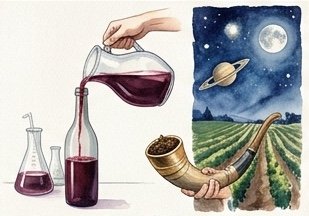
Biodynamics uses a series of preparations (numbered 500 to 508) to stimulate the life of the soil and the plants. The best known is 500: cow manure fermented inside a horn buried in autumn and dug up in spring, which is applied dynamised in the vineyard.
These preparations are not meant to replace any nutrient but to activate biological processes that strengthen the plant’s health from within. Those who use them argue that, in the long run, the soil gains life and the grape expresses its terroir better; there is no conclusive scientific evidence that confirms it.
- 500: cow manure fermented in a cow horn; buried in autumn and recovered in spring.
- 501: ground quartz (silica) in a cow horn; buried in spring and recovered in autumn.
- 502: yarrow flowers in a deer bladder.
- 503: chamomile flowers in a cow intestine.
- 504: nettle.
- 505: oak bark in the skull of a domestic animal.
- 506: dandelion flowers in a cow mesentery.
- 507: valerian flower juice.
- 508: horsetail infusion, used as a preventive against fungal diseases such as downy mildew.
After recovery they are ground, dissolved in water and applied in minimal doses: for some, only about four grams per hectare. That is why biodynamics is often compared to homeopathy: no active ingredient is found in analysis, and to date there is no solid scientific evidence that these preparations act by themselves. Those who practise them with conviction maintain that something happens; we cannot prove it, and that is why we say it this way.
Frequently asked questions
Is there biodynamic wine in the Valencian Community? Yes. At Terroir Radical we work with SK Viticultores, in El Comtat (Alicante), which has one wine in the catalogue (TEO El Sofre), and with Bodegas 9c+, in Chulilla (Los Serranos, Valencia), whose wine is coming soon. We do not claim this is an exhaustive list: it is what we know and have been able to check.
Is biodynamic the same as organic or natural? No. Organic has an official European certification. Biodynamic describes how the vineyard is farmed, with its own preparations and calendar. Natural describes mainly how the wine is made in the winery. One wine can be all three, but it need not be.
Are biodynamic wines certified? Some are, through private certifications such as Demeter or Biodyvin. Others are not, although the producer works the same way. At Terroir Radical we do not require certification, although we accept it as proof: a verifiable practice is enough, which we check through direct contact, technical sheets and, when possible, a visit. We explain it in our criteria.
Do biodynamic wines contain sulphites? It depends on the winemaking, not the vineyard. TEO El Sofre, the SK Viticultores wine in our catalogue, declares minimal sulphites (12 mg/l of total SO₂). For any new wine we classify total SO₂ in three levels: no added sulphites, minimal sulphites (up to 30 mg/l) and minimal intervention (less than 50 mg/l).
Where can I buy Valencian biodynamic wine? In the Terroir Radical online shop.
In short
- Lunar calendar — Field and winery tasks are adapted to lunar and planetary cycles.
- Biodynamic preparations — Natural compounds to stimulate soil life and vine health.
- Self-sufficient farm — Animals, plants and soil in balance. Nothing comes from outside if it can be generated inside.
Wines from biodynamic vineyards
Mediterranean producers who work the land as a living organism, vintage after vintage.
Keep reading
- Organic, biodynamic or natural wine: the real differences
- Natural wine: what it is and where to buy it
- The Valencian Community
Sources: Regulation (EU) 2018/848. Last reviewed: 4 November 2026.